
Hyperbaric Oxygen Chambers
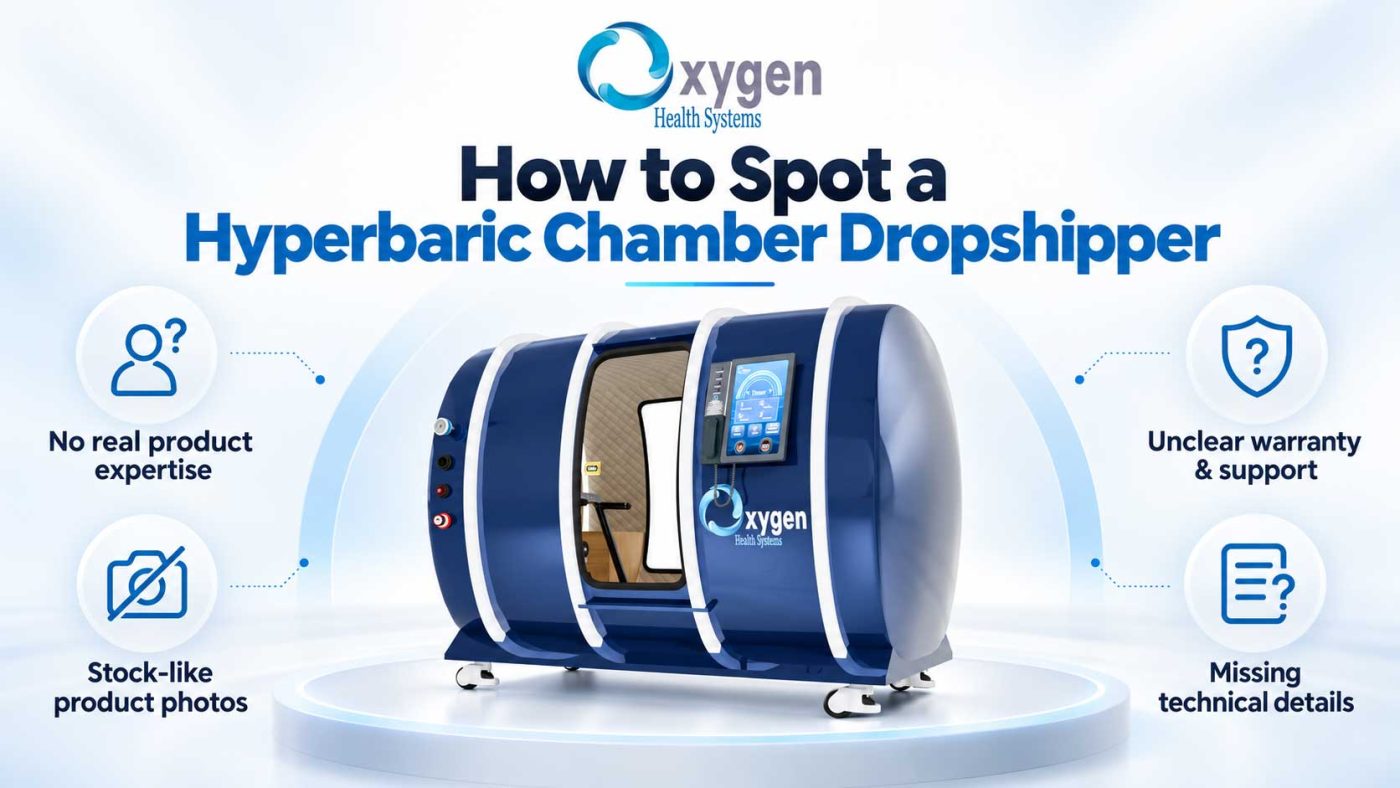
How to Spot a Hyperbaric Chamber Dropshipper
Oct
Hyperbaric therapy has become a lot more popular over the past few years, and the supply side has changed to match. Alongside the manufacturers who’ve been building this equipment for years, a category of seller has appeared that takes orders online and forwards them to an overseas factory, with the chamber shipping directly to the buyer.
There’s nothing inherently wrong with a distribution model. The problem specific to this product is that a pressure vessel for human occupancy needs someone accountable for it after the sale, and a seller who has never physically handled the unit can’t be that person. This article explains how to tell the two apart before you commit.
Why It Matters More Here Than In Other Categories
If a drop shipped kitchen appliance fails, you’ve lost a few hundred dollars and an afternoon. The stakes with hyperbaric equipment sit somewhere else entirely.
Nobody in a drop shipping chain has pressure tested your specific chamber, because the unit went from the factory floor to a freight forwarder to your driveway. Nobody holds build documentation for it, which means a hyperbaric engineer later asked to service it has no record of what it was constructed to or tested at. Nobody has parts on the same continent. And when a fault develops, the seller’s only real option is to pass your message to a factory in a different time zone and hope for a reply.
That’s the practical difference. The chamber might be fine for years. If it isn’t, you’re on your own with it.
Signal One: No Physical Premises
Start with the address. A manufacturer or a serious distributor has somewhere the equipment physically is, and they’ll usually be pleased to show you.
Look for a street address on the website, and check it. Put it into a maps search and look at the street view. A commercial or industrial building with the company’s name on it is what you want to see. A residential address, a mailbox service, a coworking space or a vacant lot tells you the chambers aren’t there.
Then ask the direct question: can I come and see one? A seller with stock says yes and offers times. A seller without stock will explain why a visit isn’t possible, and the explanation usually involves warehousing arrangements, appointment only policies or a facility that’s temporarily unavailable.
We keep chambers on display at our showroom near Chicago, and visitors are welcome to come and see the equipment before buying anything.
Signal Two: A Very Short Trading History
Check how long the company has existed. There are several independent ways to do this and they should agree with each other.
Look at the domain registration date through a public whois lookup. Look at when the Google Business Profile was created and when the earliest reviews were posted. Look for the company name mentioned anywhere outside its own website more than a year ago. Check whether there’s a Better Business Bureau listing and how old it is.
A company founded eight months ago can still be legitimate. What should concern you is a mismatch, such as a website claiming twelve years of experience attached to a domain registered last spring.
Oxygen Health Systems has been trading for ten years and holds a BBB A+ rating, and all of that is checkable through the sources above.
Signal Three: Product Photography That Isn’t Theirs
Reverse image search the product photographs. If the same images appear on a factory listing page and on several other retail websites under different brand names, you’re looking at catalogue photography supplied by a manufacturer to its resellers.
Sellers with their own stock tend to have their own photographs, with their own premises visible in the background, plus video. Our videographer visits our facility regularly and films the actual chambers in our showroom, which you can see across our YouTube channel.
Signal Four: Certification Claims That Won’t Resolve
This is the most useful test, because it’s the hardest to fake and the answer arrives quickly.
Ask for the certification documents. Ask for the certificate number, the issuing body and the scope statement. Ask which specific models each certification covers.
A seller who’s forwarding orders to a factory usually can’t produce these, because the certificates belong to the factory, may be issued to a different legal entity, and may cover a different model line to the one being sold. What you’ll get instead is a reassurance in an email, or a logo on a webpage with nothing behind it.
Everything we hold is listed on our certifications page, including ISO 13485, ISO 9001:2015 and ISO 14001, our chambers carry CE marking and are built to NFPA standards, and one chamber in our range holds ASME PVHO-1 certification. Where something applies to one model, we say which model.
Signal Five: Support That Has No Location
Ask where the support team physically sits and what hours it works. Then test it before you buy by calling the number during US business hours.
If you reach a person who can answer a technical question about the equipment, that’s a good sign. If you reach a form, a chatbot or a voicemail box, and the reply arrives overnight in slightly stilted English, you’ve learned where the support actually is.
Our support team is based in the US and available seven days a week, and you can call and speak to someone about a chamber before you’ve bought anything.
Signal Six: No Installation Or Training Involvement
A supplier who understands the equipment will want to know about your space before taking your order. Room dimensions, doorway widths, power supply, floor loading and ventilation all matter, and a seller who doesn’t ask about any of them isn’t thinking about what happens on delivery day.
Training is the same test. A chamber is operated equipment, and a supplier who treats training as your problem has told you how involved they plan to be. We include free Zoom training with every chamber and go through the installation requirements before an order is confirmed.
A Ten Minute Verification Routine
Run this on every supplier on your shortlist.
- Search the address and look at it on street view
- Check the domain registration date
- Check the Google Business Profile creation date and earliest reviews
- Check for a Better Business Bureau listing
- Reverse image search two product photographs
- Email asking for certification documents with scope statements and model coverage
- Call the support line during US hours and ask a technical question
- Ask to visit their showroom
Eight checks, about ten minutes of work, and a twenty thousand dollar decision made on evidence.
If You’d Rather Just Come And Look
You’re welcome to visit our showroom near Chicago, see the chambers, meet the people who’d be supporting you afterwards, and ask anything on the list above in person. Our team is available seven days a week if you’d like to arrange a time or talk it through on a call first.