
Hyperbaric Oxygen Chambers
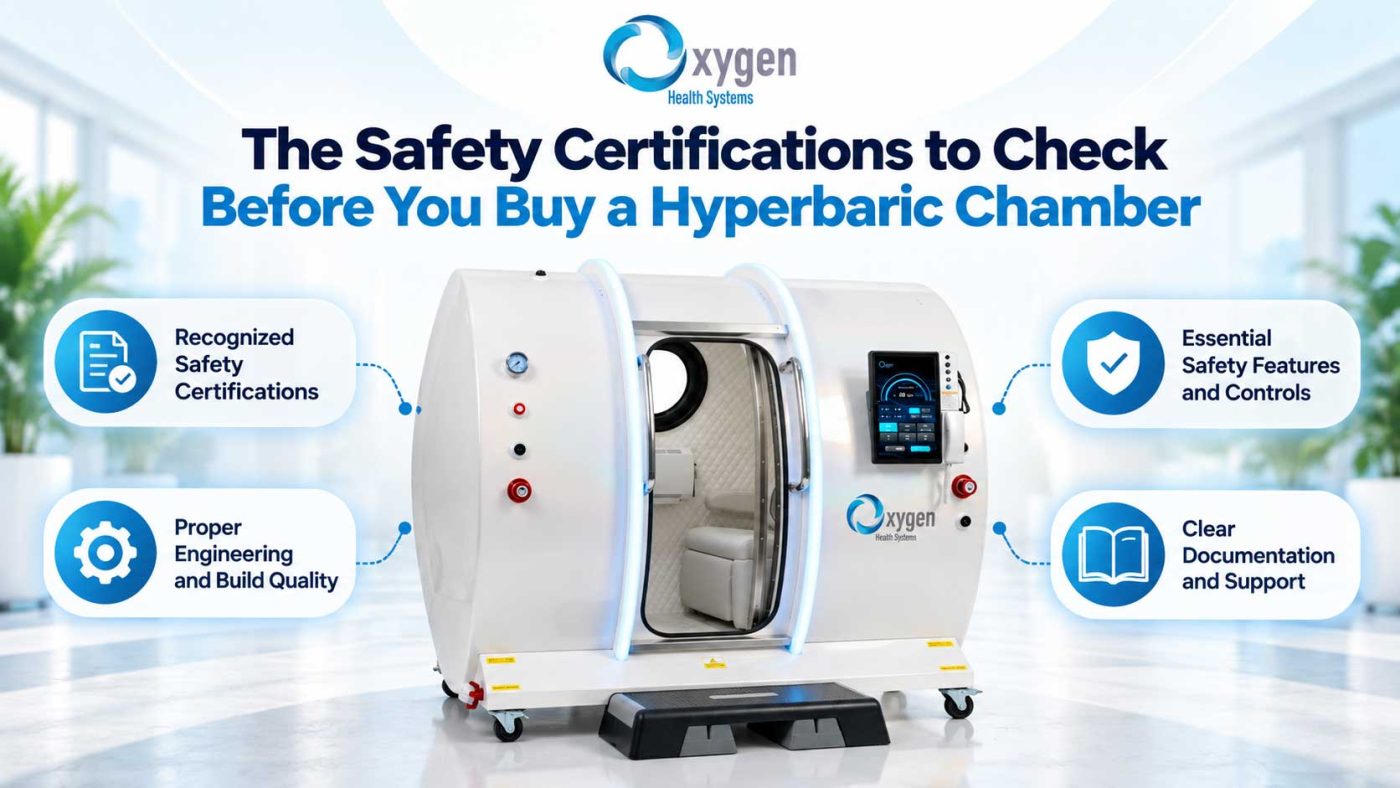
The Safety Certifications to Check Before You Buy a Hyperbaric Chamber
Oct
A hyperbaric chamber is a pressure vessel. It holds a person inside a sealed environment at above atmospheric pressure, sometimes for an hour or more at a time, and it does that several times a week for years. The engineering behind it has to be right, and the only practical way for a buyer to confirm that it’s right is to look at which independent standards the manufacturer works to.
Certification language gets used loosely in this industry. Plenty of websites list impressive sounding acronyms without explaining what any of them cover, and some list standards that apply to a component inside the chamber while implying they apply to the whole unit. This guide explains what each of the main standards actually covers, so you can read a specification sheet and understand what you’re looking at.
ISO 13485 And Why It Matters Most
ISO 13485 is the quality management standard written specifically for medical device manufacturing. It governs how a manufacturer designs a product, how it documents changes, how it handles materials and suppliers, how it records every stage of production, and how it traces a finished unit back through its build history.
That last point is the one buyers tend to underestimate. If a manufacturer holds ISO 13485, there’s a documented record tied to your specific chamber: which components went into it, who assembled it, what it was tested at, and when. If a component batch is later found to be faulty, the manufacturer can identify every unit affected. Without that system, there’s no reliable way to trace anything.
Oxygen Health Systems is certified to ISO 13485, and every chamber we build goes through that documented process.
ISO 9001:2015 For Consistency Across Builds
ISO 9001:2015 is the broader quality management standard, and it applies to how the whole business runs rather than just the manufacturing floor. It covers process consistency, corrective action when something goes wrong, supplier management, and continuous improvement.
The practical effect for a buyer is that the chamber you receive is built the same way as the one built six months ago and the one that’ll be built six months from now. Small manufacturers without a quality system often have significant variation between units, because the person assembling them makes judgement calls that aren’t recorded anywhere.
ISO 14001 For Environmental Management
ISO 14001 covers environmental management systems. It’s less directly connected to your safety as an operator, so it’s fair to treat it as a secondary signal. What it does tell you is that the manufacturer is running audited management systems across multiple areas of the business, which is a reasonable proxy for organisational maturity. A company that’s passed three separate ISO audits isn’t operating out of a rented unit with no documentation.
ASME Standards And Pressure Vessel Engineering
The American Society of Mechanical Engineers publishes the codes that govern pressure vessel design and construction in the United States. For hyperbaric equipment, the relevant code is PVHO-1, which covers pressure vessels for human occupancy.
PVHO-1 sets requirements for the design calculations, the materials, the viewport construction, the welding, the pressure relief systems, and the testing regime. It exists because pressure vessels containing people have a different failure profile to pressure vessels containing gas or liquid, and the acrylic viewports in particular need specific treatment.
This is an area where you need to read claims carefully. A manufacturer might build one model to PVHO-1 and then describe the brand as PVHO certified across the board. At Oxygen Health Systems, one chamber in our range holds ASME PVHO-1 certification, and the rest of our ASME code compliant chamber range is built to the same code. If a certification applies to a specific model, we say which model.
CE Marking
CE marking indicates that a product conforms to the relevant European health, safety and environmental requirements. It’s a manufacturer’s declaration of conformity supported by a technical file, and for higher risk categories it involves a notified body.
CE marking is useful supporting evidence. It shouldn’t be read as equivalent to a full quality management certification, because the two things do different jobs. Our chambers carry CE marking alongside the ISO certifications above.
NFPA Standards And Fire Safety
The National Fire Protection Association publishes the standards that govern fire safety in oxygen enriched environments, and NFPA 99 is the one most relevant to hyperbaric equipment. Elevated oxygen concentration lowers the ignition point of materials that are perfectly safe at normal atmospheric oxygen levels, which is why the materials used inside a chamber matter so much.
Grounding, static control, interior material selection, and the exclusion of unapproved electronics are all covered by this area of standards. Our chambers are built to NFPA standards, and our training covers what can and can’t go inside a chamber during a session.
Business Accreditation And Track Record
Certifications tell you about the product. Business accreditation tells you about the company behind it, and for a purchase at this price point both matter.
Oxygen Health Systems holds a BBB A+ rating and has been building hyperbaric chambers for ten years. Check the Better Business Bureau listing, the Google Business Profile, and the review history of any supplier you’re considering. A company with no verifiable trading history is a risk regardless of what its specification sheet says.
How To Verify Any Certification Claim
Certification claims are easy to make and reasonably easy to check. Here’s what to ask for:
- The certificate itself, in full, showing the certification body, the certificate number and the expiry date
- The scope statement on the certificate, which tells you what activities and products are actually covered
- Confirmation of which models a product specific certification applies to
- The name of the certification body, so you can verify the certificate through their public register
Any legitimate manufacturer will send these without hesitation. If a supplier gets vague when you ask for documentation, that tells you something.
You can see our full certification documentation on the Oxygen Health Systems certifications page.
Bringing It Together
Work through the list in order of weight. ISO 13485 tells you there’s a documented medical device quality system behind the build. ASME code compliance tells you the pressure engineering has been done to a recognised standard. NFPA standards tell you the fire risk has been designed out. CE marking and ISO 14001 support the picture. Business accreditation and trading history tell you whether there’ll be anyone to call in three years.
If you’d like to talk through the certifications on a specific model, or come and see a chamber in person, our showroom is in the Chicago area and our team is available seven days a week.